Materials I use for my paper art
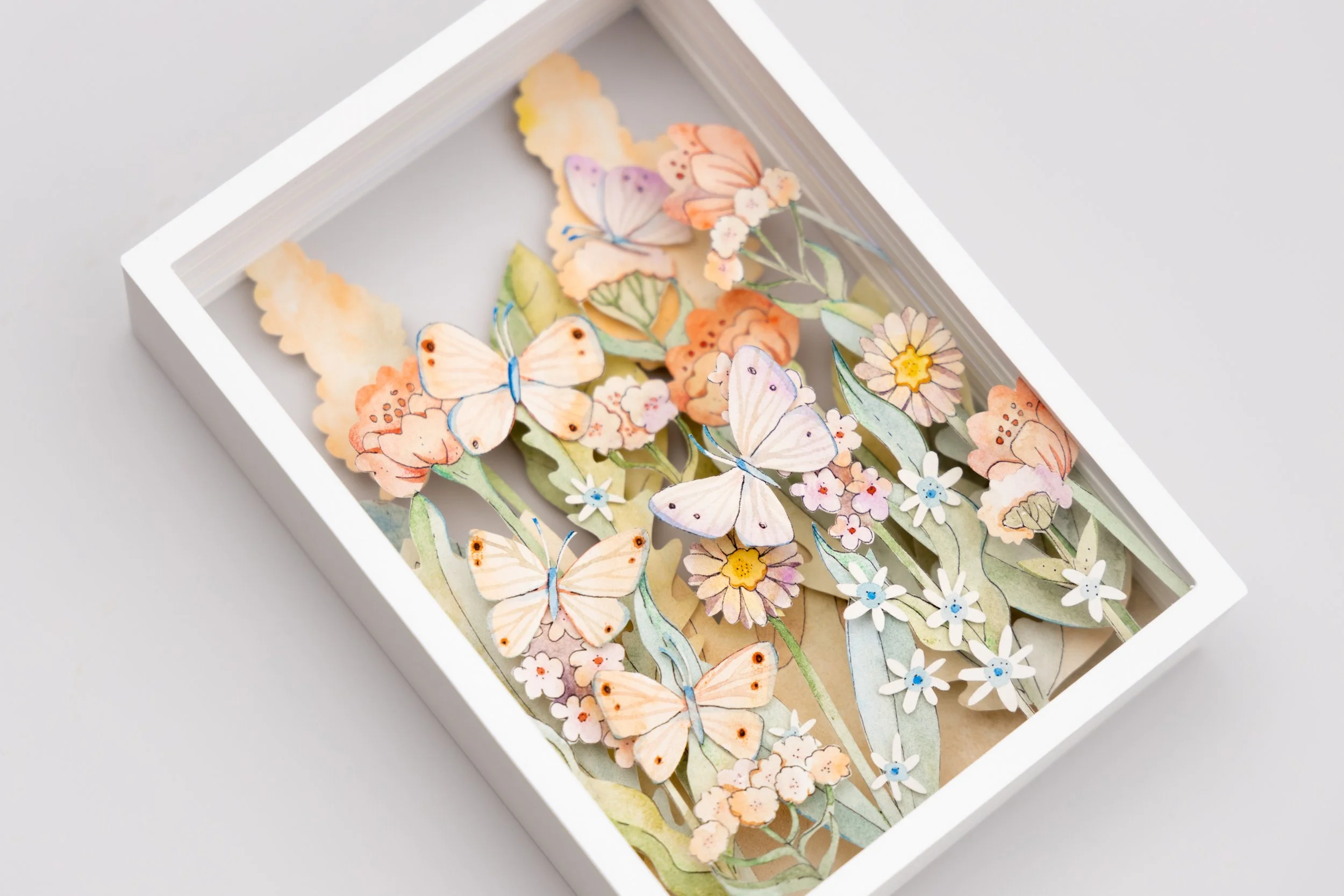
I often get questions about the tools and materials I use in my paper art - what kind of paper I choose, what paints I prefer, or which cutting tools work best. So I thought it might be helpful to gather everything in one place.
This list is a reference guide to the materials I personally use and love - the same ones you’ll often see in my photos and videos. Think of it as a peek into my toolbox rather than a shopping list.
You absolutely don’t need everything here to start creating. Many of my early projects were made with whatever I already had at home - and honestly, that still happens. The right materials can make the process smoother, but creativity matters far more than the tools themselves.
Still, if you’re curious about what I use or want to try something similar, here you’ll find all my favorites, along with little notes on why I like them and how they fit into my process.
🧾 Paper
When it comes to paper, I almost always reach for watercolor paper or mixed media sketch paper - something that can handle a bit of water and color without curling or bleeding. My main coloring tools are watercolors and gouache, so I like paper that lets the paint blend softly but still keeps nice, crisp edges.
For most of my smaller pieces, I use lighter paper - around 90–100 gsm - because it’s easy to cut and layer. If I’m working on something larger, like A5 or A4 size, I’ll go for something sturdier (around 120–160 gsm) so the layers hold their shape better.
You definitely don’t need to buy the most expensive brand - honestly, some of my favorite results came from very ordinary sketch paper. What matters more is how the paper feels under your knife and brush. If it bends and paints well, that’s your perfect paper.
✂️ Cutting Tools
My precision knife is probably my most-used tool - it’s been with me for years, and I reach for it in every single project. The one I use is a bit heavier than the usual craft knives you find in art stores, and I love that extra weight. It sits nicely in my hand and makes the cutting feel more controlled and steady.
If you’re using a precision knife, the blade makes all the difference. I use #11 blades - the classic craft / x-acto knife shape - and I change them quite often. Ideally, start each new project with a fresh blade; it gives you those smooth, effortless cuts that make paper edges look clean and crisp. I buy them in bulk boxes of 100 (because I go through them fast), but you can easily get smaller packs if you’re just starting out. The main thing is: never use a dull blade. They tear more than they cut, and it’s never worth the frustration.
Alongside the knife, I keep two pairs of scissors nearby: one small and one large.
The small pair is perfect for quick trims or small pieces that don’t need precise knife cuts.
The larger pair I use for cutting down big sheets - for example, trimming A3 paper to A6 size before I start.
Simple tools, but having both at hand saves so much time.
📏 Cutting Mat
If you work with a knife, you absolutely need a cutting mat - it protects your desk and keeps your blades sharper for longer. I use an A3-size mat, which feels like the sweet spot: large enough to give me room to work, but not so big that it takes over my entire workspace.
After a bit of trial and error, I found I really prefer softer cutting mats. For delicate paper cuts, a soft mat lets the blade glide more easily and helps maintain that clean edge. Some mats are made for tougher materials like fabric or leather - they’re harder, and you have to press more firmly to cut through. That’s not ideal for paper; you want something that gives just a little under the knife.
It’s a small detail, but it really makes a difference in how clean your cuts look and how long your tools last.
🤖 Cutting Machine (Cricut)
I also own a Cricut Explore Air 2 - the green one - and while I don’t use it often for my main cutting, it definitely has its place in my process. I originally bought it to make sure the templates I design would cut well on a Cricut, and it’s been very helpful for testing.
In my own work, though, I still prefer cutting by hand. Most of my shapes are quite organic and I find those cuts look best when done manually with a precision knife. There’s something about hand-cut edges that adds a bit of character and warmth that a machine can’t quite replicate.
That said, Cricut is wonderful for clean, geometric cuts - especially things like frames, spacers, and boxes, where perfect 90-degree angles really matter. It’s nearly impossible to get those lines as sharp and square by hand, and that’s where the machine shines.
If you’re more comfortable working digitally or just prefer the convenience, Cricut (or any similar cutting machine) can absolutely handle these templates. I test all my files to make sure they’re machine-cuttable - so whether you prefer scissors, a precision knife, or a Cricut blade, everything should fit together beautifully.
✏️ Pencil & Liner Pens
Before any cutting or coloring begins, I always start with a sketch. Sometimes it’s just a few light lines to map out where I want things to go - sometimes it’s more detailed - but I always begin with pencil and liner.
For sketching, I use a mechanical pencil with a 0.5 mm lead. It’s sharp, consistent, and never needs sharpening, which makes it perfect for fine details. I’ve been using the same pencil for years, and at this point, it feels like an extension of my hand - comfortable, familiar, and reliable.
Once I’m happy with the sketch, I go over the important lines with a fine liner pen - as thin as I can find. The key is to use one with archival ink that’s waterproof, so the lines won’t blur when you start painting with watercolors or gouache. That small detail makes a big difference; it keeps everything crisp and clean even when working with wet media.
🎨 Coloring Materials: Watercolors, Gouache & Pencils
Color is one of my favorite parts of the creative process - it brings everything to life. In my designs, I mostly work with three types of coloring materials: watercolors, gouache, and watercolor pencils. Each has its own charm, and I often mix them together in my own slightly unconventional way.
I’ve loved watercolors since school. My palette is definitely more then 10 years old now - a few color cells have been replaced over time, but it’s still my trusty companion. I love how watercolors flow and blend, and how they create those soft, delicate shades that define much of my work.
Every so often, I also use gouache paints. They’re still water-based, but less translucent, with a beautiful matte finish. I often mix gouache with watercolor directly on the lid of my palette. It’s not the traditional way of using gouache, but it works perfectly for me - especially when I want colors that are both soft and a bit more saturated.
I also like to add small details and finishing touches with watercolor pencils. They’re perfect for highlighting certain elements, adding shadows, or emphasizing fine details that need a little extra attention. I usually bring them in at the very end of a project, when I can see the whole piece and notice which parts could use a bit more depth or contrast.
Something I haven’t tried yet - but really want to - is acrylic markers. I’m curious to see how they might work as a bridge between painting and drawing: colorful, bold, but also neat and controlled.
Over time, I’ve experimented with many combinations of these materials. In fact, my very first shadow box was designed on my iPad, printed, and then colored with watercolors. The second one was entirely hand-sketched and painted with watercolor pencils. I love that freedom to mix and match - it keeps each project a bit of an exploration.
🩷 Adhesives: Glues & Tapes
Once all the pieces of your artwork are ready - drawn, colored, and cut - it’s time to bring them together. And that’s when adhesives become your best friends.
There are many ways to glue paper, and none of them are “wrong.” I started out using simple PVA paper glue and glue sticks, and they worked perfectly fine. They’re great for beginners and small projects.
But over time, I realized something: I often want to move things around - shift a butterfly slightly higher, or adjust a flower’s position once I see how everything fits together. And once something is glued down with PVA, that flexibility is gone (and sometimes, so is a bit of damaged paper).
That’s when I switched to tape - and it completely changed how I work.
A simple office tape already gives you more freedom to reposition elements. It’s less sticky than glue, which might sound like a downside, but when you’re refining your composition, it’s a huge advantage.
These days, my go-to adhesives are two kinds of tape:
Double-sided tape - simple, strong, and endlessly useful. You can cut the tiniest pieces and they’ll hold beautifully. It gives you the precision of glue but without the mess.
Double-sided foam tape - my new favorite tool for adding depth. It slightly lifts elements off the surface, creating soft shadows and a beautiful 3D effect. I use it to make details “pop” without adding extra paper layers.
With these two, I can build dimension, adjust layouts, and experiment freely. And while I still keep a glue stick around (it’s a classic for a reason), I mostly use tape.
✂️ Little Essentials & Handy Extras
There are also a few small things I keep around that make the creative process smoother - nothing fancy, but all incredibly useful in their own way.
If you use paints, a set of thin brushes is essential. You’ll want something that lets you work on details comfortably. I don’t have a favorite brand or type - I just use what I have, and when a brush gets too old, I replace it. Simple as that.
I always keep a couple of erasers on hand. One is very soft and gentle, perfect for general use. The other is something a friend once gifted me - it looks like a pencil, but instead of graphite, it’s made entirely of eraser. You sharpen it just like a pencil, and it gives you an incredibly fine tip, perfect for erasing tiny details with precision. I didn’t know I needed it until I had it.
Another small but powerful tool is my white liner pen. It’s filled with white ink and works wonders for final touches - little highlights, reflections, or dots that bring a piece to life. Sometimes a single white line can completely change the mood of a drawing.
I also have a metal ruler and use it all the time. Simple, sturdy, and perfect for straight lines.
On my desk, there’s always a stack of sticky notes. They’re my mini sketchpad for spontaneous ideas or quick drafts. I prefer them over a real sketchbook because they completely remove that feeling of “this needs to be perfect.” Sticky notes are casual by nature - they give you permission to make a mess, which is often where the best ideas start.
And next to that, I keep a small notebook for random thoughts. Crafting, for me, is a very meditative process - my hands work, and my mind wanders. Sometimes ideas, memories, or plans float by, and I like jotting them down before they drift away.
And, as a little post scriptum: when I’m crafting, I almost always have something playing in the background - usually a podcast or a YouTube video. My all-time favorite (and the one I plan to re-listen to) is The Magnus Archives. Definitely not an art supply, but perhaps an essential in its own way.
🖼️ My Custom 3D-Printed Shadowbox Frames
One thing I get asked quite often is what I use to frame my shadowboxes. For a long time, I used paper frames - but as I started making more of my shadowbox artworks, that didn’t feel very sustainable. So, together with my partner (who happens to have a small 3D-printing hobby business), we designed our own custom 3D-printed shadowbox frames.
They’re made from PLA, a recycled and recyclable material, which makes them both sturdy and eco-friendly. Each frame consists of an inner and outer frame, plus spacers to create that beautiful layered depth. From a distance, they almost look like paper - very light, very clean - but strong enough to last through endless creative experiments.
We designed them in white and black, to mimic the look of paper, and we make them in a few handy sizes: A6, A5, and a tiny matchbox size (which I absolutely adore). I use them in all my own designs, and they’ve completely changed my workflow - especially since I can assemble and reassemble them as many times as I like without worrying about tearing or bending anything.
They’re available for purchase, and we print and ship them ourselves from our home in the Netherlands - worldwide.
🌿 Final Thoughts
And that’s my collection of tools and materials - the things I reach for most often when I create. But before you go and fill your cart with supplies, let me say this clearly: you absolutely don’t need all of it to start.
Art doesn’t come from the tools - it comes from the hands (and the mind) that use them. A basic pencil, a sheet of paper, a bit of curiosity - that’s already enough. The rest comes with time, experience, and, honestly, a bit of playful experimentation.
The tools I listed here are simply the ones that grew with me, step by step, as I learned and explored. Think of them as a reference, not a checklist - a source of ideas rather than a rulebook.
So start where you are, use what you have, and let your creativity do the rest.